Category: bread

  • Fergazza

    Fergazza

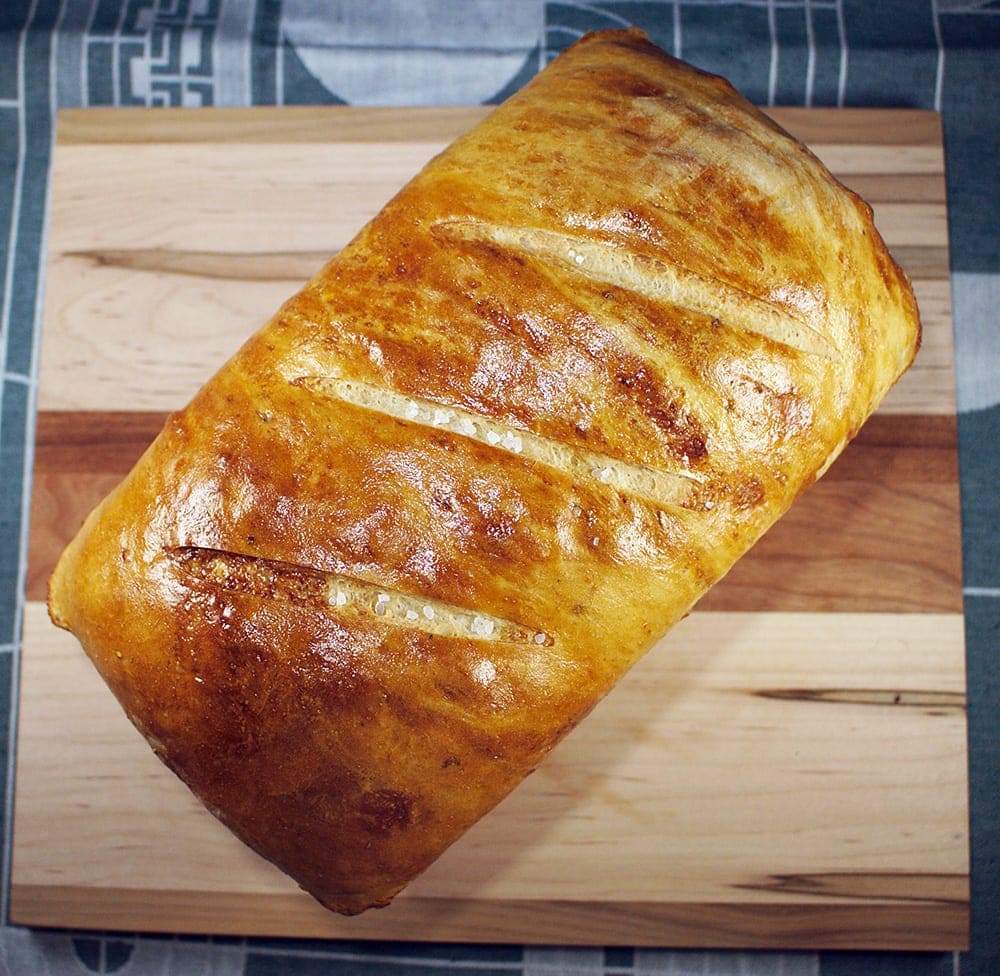
    This might not actually be called fergazza. It might not even exist. I can’t really find any reference to it besides the recipe I found and use to make it. We subscribe to a CSA, so every summer we get a bunch of random and sometimes unusual vegetables delivered to us every week. Last summer we got garlic scapes one week. I didn’t even really know what they were, let alone what to do with them. I did some googling and found this recipe. It was an instant hit with my wife. This week I didn’t have any garlic scapes, but I did have ramps, so I decided to give it a go with those instead.

    I think the garlic scape version has a better texture. The heavier bodied scapes give a nice little bite whereas the ramps got more soft, but the taste was still great. I also had a problem with this version with it collapsing a bit (ok, a lot) in the middle, as you’ll see in the next picture..

    I suspect the higher water content of the ramps had a part to play in this, as well as possibly using a bit too much filling. I might try a bit less water next time to make up, and maybe try to roll it tighter so it has a better chance of staying together. Ideally I would just actually use garlic scapes next time, but they aren’t real easy to come by. I think the general recipe could probably be used for any sort of vegetable you want, especially something stemy. Rhubarb might make a nice dessert version. I’ll have to experiment more.

    Fergazza

    Stuffed bread with cheese, hot sauce, and garlic scapes or ramps.

    • 1 1/4 cup Lukewarm Water
    • 1 tbsp Sugar
    • 1 tsp Yeast
    • 3 cups All Purpose Flour
    • 4 tbsp Extra Virgin Olive Oil
    • 1 1/2 tsp Coarse Salt
    • 1 tsp Dried Oregano
    • 1/2 tsp Ground Black Pepper
    • 1/2 lb Shredded Sharp Cheddar
    • 1/2 cup Garlic Scapes or Ramps
    • 1 tbsp Sriracha or Hot Sauce of Choice
    • 1 clove Minced Garlic
    1. Combine the water, sugar, and yeast in the bowl of a mixer. Let sit a few minutes until foamy.

    2. Add flour, 1 tbsp olive oil, the salt, pepper, and oregano. Mix until it forms a shaggy dough.

    3. Form into a ball and place in an oiled bowl. Cover and let rise for two hours or until doubled.

    4. Mix 2 tablespoons of olive oil with the hotsauce and garlic.

    5. Flour your work surface and roll out the dough until it is about 10″x14″. Brush the hotsauce mixture over the brad. Sprinkle the cheese and vegetables evenly over the dough.

    6. Roll the dough up and fold the ends under forming a loaf. Please the loaf in a greased loaf pan and let rise another 90 minutes.

    7. Cut some slashes in the top and sprinkle with coarse salt. Cook at 350F for 45-50 minutes.

  • Sourdough Deux

    Sourdough Deux

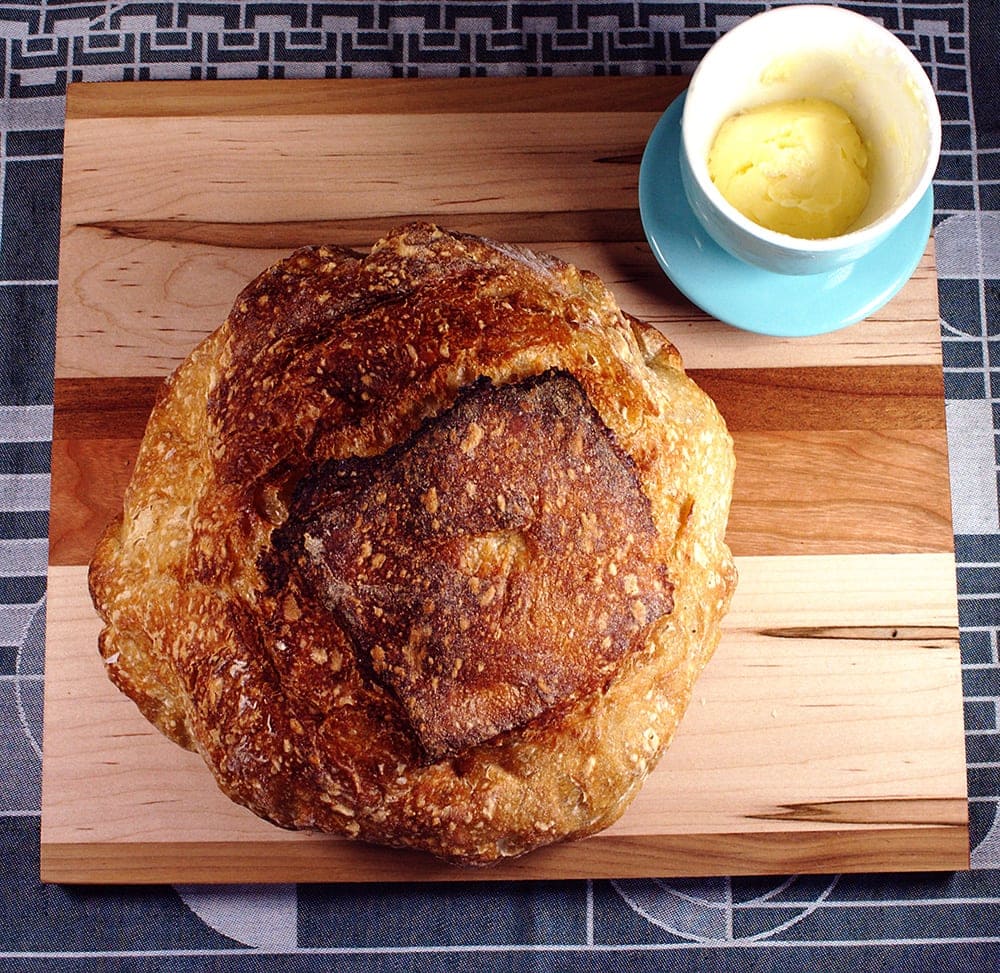
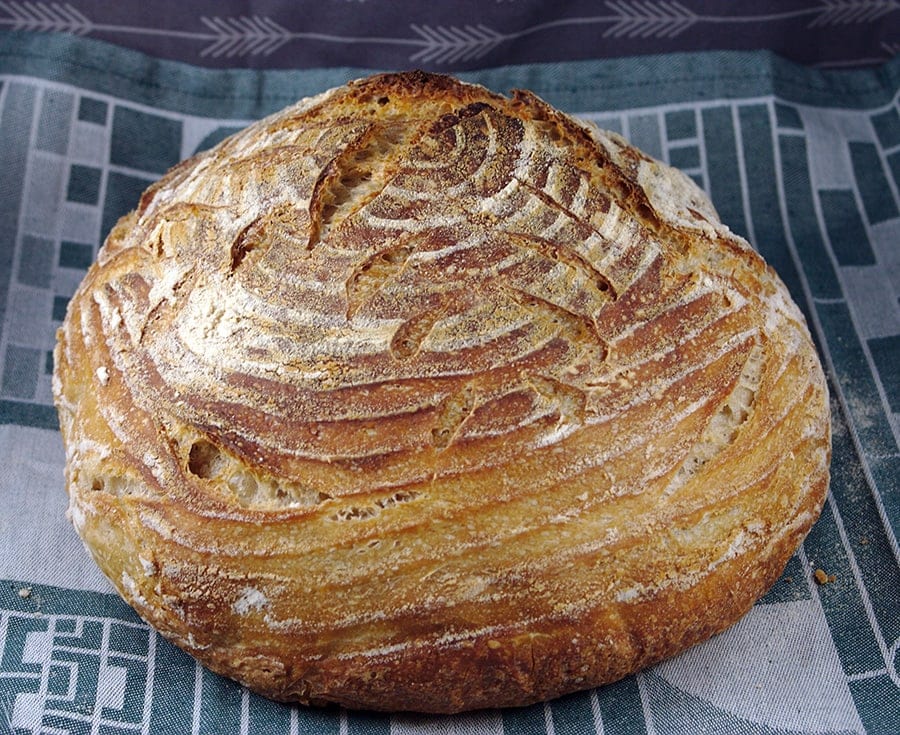
    After another week of cultivating Ziggy Stardough, I tried my second batch of sourdough. I fell like the sourdough flavor was much more pronounced this time around. I also tried to do a more traditional scoring job and create a classic ear on the loaf.

    I’m particularly proud of the above shot because not only did I obviously bake the bread, but I also hand churned the butter, and even crafted the cutting board it’s all sitting on.

    Crumb
    “All right, Mr. DeMille, I’m ready for my close-up.”
  • First Sourdough!!

    First Sourdough!!

    I finally baked my first sourdough. A sourdough starter is basically a pet. People keep them alive for years, or generations. There is a starter that was brought cross country on the Oregon trail in the 1800s that a group of people are still keeping alive today. At the famous Boudin bakery in San Francisco their starter has been around since 1849, and survived the 1906 “Great Earthquake”. So yeah, starters can be pretty serious business. My wife and I already have three fur babies, so another pet is a commitment. I finally took the plunge two weeks ago. Following the King Arthur Flour recipe and care instructions, I established a starter. I have dubbed him Ziggy Stardough. He lives in a glass jar on the kitchen counter for now, but I’m still figuring out the details of long term accommodations.

    This weekend I decided the starter was good and established enough to bake my first loaf. I followed the recipe from Brooklyn Sourdough, who’s Instagram you should follow if you don’t already. She does amazing scoring work and produces beautiful loaves.

    No Knead Sourdough

    From Brooklyn Sourdough.

    • 80 g Whole Wheat Flour
    • 320 g Bread Flour
    • 272 ml Water
    • 240 g Starter
    • 8 g Salt

    Day 1

    1. Autolyse. Combine all the flours and the water, mix, and let stand covered at least 30 minutes.

    2. Mix the starter into the flour and water mixture, and let sit another 30 minutes. (you probably wan’t to feed / replenish your starter after taking the 240 grams)

    3. Sprinkle the salt on top and fold and pincer it in. Let set, covered, for 1 hour.

    4. Perform 3 stretch and folds of the dough, 1 ever 30 minutes, for 90 minutes. Let sit another 30 minutes when done.

    5. Flour (with rice flour or something low in gluten) a banneton. Place the loaf in the banneton. Leave to rise in the fridge, covered, for 12-20 hours. (I just baked when convenient the next day, which was about 17 hours)

    Day 2 (Baking)

    1. Place a dutch oven in the oven and preheat to 500F.

    2. Turn the dough out onto parchment paper that you have sprayed with some water.

    3. Score the loaf as you’d like, if you’d like.

    4. Using the parchment to lift the dough, carefully place it in the preheated dutch oven.

    5. Lower the oven to 450F and bake, covered, for 30 minutes.

    6. Remove lid and cook another 15 minutes.

    7. Carefully remove from the dutch oven, discard the paper, and let cool as long as you can stand.

    It came out beautifully, one of the nicest looking loaves I’ve ever made. It tasted pretty great too. The texture was decent, the dough didn’t rise as much as I would have liked, so I’ll need to experiment. Despite that, it wasn’t really dense or stodgy, just not quite as loos and fluffy as I’d like. I can’t wait to do more experiments with different variations, and to work on my scoring skills.

    Why yes, I did stand on a chair to take this phot.
    The money shot.
    Look at the ridges!
  • Overnight White

    Overnight White

    I started baking bread after being inspired by Paul Hollywood. Paul is a very old school, knead it by hand until your hands are aching kind of guy. It can be, frankly, a pain in the butt. As I read more about baking on reddit and other websites, I started seeing people talking reverently about ‘FWSY’ and no-knead bread. The ubiquitous ‘FWSY’ turns out to be shorthand for ‘Flour, Water, Salt, Yeast’, a book by Ken Forkish, owner of Ken’s Artisan Bakery in Portland, which has become sort of the new testament of bread baking for a lot of people.

    Ken’s technique centers around a few concepts that differ from a lot of traditional methods. First, it uses a very small amount of yeast. Instead of spending a long time kneading the dough you only fold it just enough to mix the ingredients fully. The proofing times are very long, these are not breads you make in one day. Lastly, the loaves are cooked at high temperature, and in a dutch oven that is fully preheated.

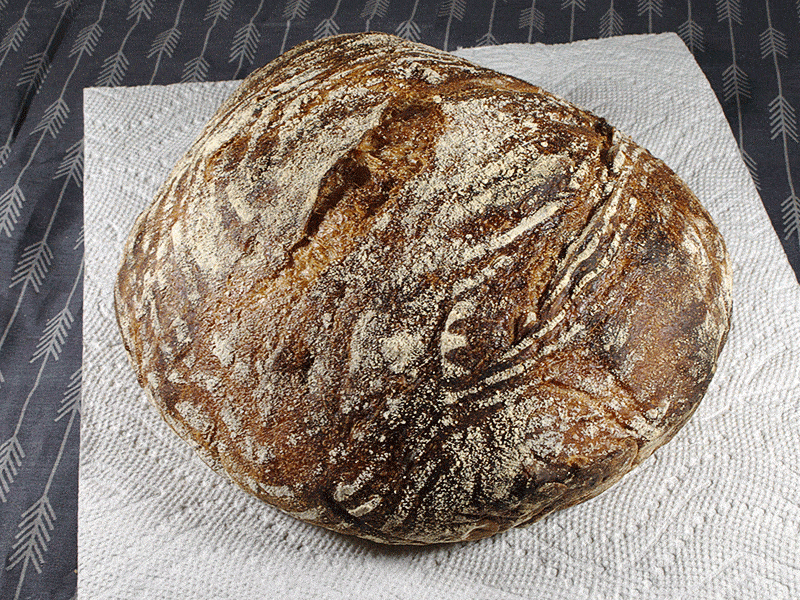
    Well.. It works. It’s time consuming, but really amazingly simple and easy. The results are always great, even when I manage to screw it up somehow, the worse that happens is I get a really ugly but tasty and crusty loaf.

    Overnight White

    From FWSY.

    • 1000 g Bread Flour
    • 780 g Water (Lukewarm (90-95F))
    • 22 g Fine Sea Salt
    • 1/4 tsp Yeast
    1. Combine the flour and the water in a big tub and mix to incorporate. Let it sit for about 30 minutes.

    2. Sprinkle the salt and the yeast over the top (but don’t let the yeast and the salt touch directly). Mix it all together with some folds initially, then with the pincer method.

    3. Let it rest for about an hour, then fold two or three more times. Cover and let proof overnight 11-13 hours more (12-14 total). Dough should be at least 2x and up to 3x as large.

    4. Tip the dough out onto a floured surface. Cut it into two equal parts. Form each part into a nice ball.

    5. Dust and/or oil two proofing baskets or bowls. Place one dough ball in each basket.

    6. Cover the bowls with a towel and proof the loaves for another hour and fifteen minutes.

    7. 45 minutes before the loaves are done proofing, preheat an oven to 475 degrees, with 2 dutch ovens inside (if you only have 1 it’s ok, see note later..).

    8. When proofing is done, carefully remove the hot dutch ovens, place a loaf in each, cover, and put them back in the oven. Let cook for 35 minutes covered.

    9. After 35 minutes, remove the tops and cook uncovered for another 15 minutes. Very, very, very, carefully tip the loaves out of the dutch ovens and let cool for at least 20 minutes.

    10. NOTE: If you only have 1 dutch oven, put the second loaf in the fridge while the first cooks. When the first loaf is done, let the dutch oven reheat for 5 minutes in the oven, and cook the second loaf, as above.

  • 100% Spelt Bread

    100% Spelt Bread

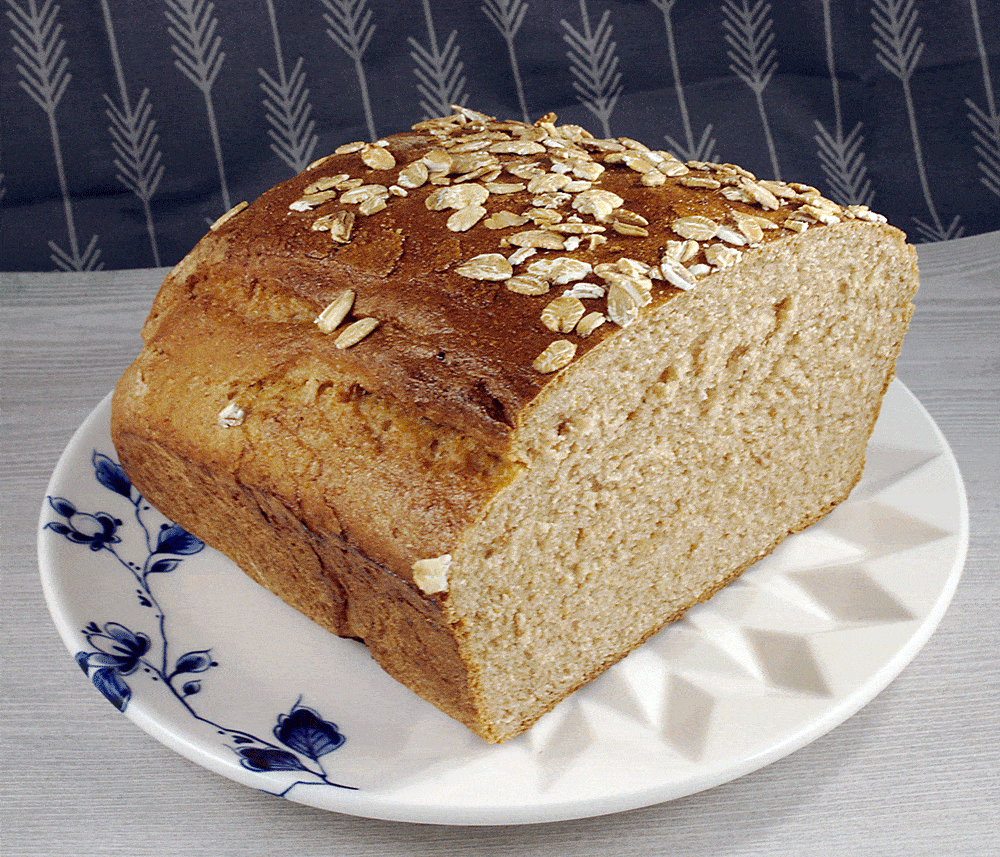
    I’ve made spelt bread before, but it was always a percent of spelt flour mixed with white or wheat. This is my first time baking an all spelt loaf. I am very pleased with results. It’s healthier than a regular white sandwich bread, with a nice flavor that is subtlety different.

    The Delft Blue plate in the photos is a souvenir from a recent trip to Curacao. The trip was amazing, but that’s a post for a different blog.

    This recipe makes three loaves, which is a lot. You can use simple math to make two or just one instead. I wanted to experiment with different toppings, so I made a bunch of loaves.

    All Spelt Bread

    100% spelt flour loaf.

    Yeast Mix

    • 2 tbsp Yeast
    • 3/4 cup Warm Water
    • 1/4 cup Honey

    Dough

    • 2 2/3 cup Warm Water
    • 1 tbsp Salt
    • 9 cup Spelt Flour
    • 9 tbsp Olive Oil

    Optional

    • 1 tbsp Cold Water ((for egg wash))
    • some seeds/oats/anything to top the loaf

    Yeast Mix

    1. Mix 3/4 cup warm water, 1/4 cup honey and 2 tbsp of yeast in a bowl and let sit for a few minutes.

    Dough

    1. Add the yeast mix and half the flour into a large bowl (or stand mixer). Stir well.

    2. When the yeast mix and half the flour are well mixed, add the rest of the flour. I combined everything with the stand mixer for a few minutes then took the dough out and kneaded by hand for about 5 more minutes.

    Proofing

    1. Preheat oven to 200F. Once it is up to temperature turn it off. Place the dough in an oiled ovensafe dough and let proof in the warm oven for about an hour. (Should double or more)

    2. Punch the dough down and split in three equal parts.

    3. Fold each piece into a loaf shape and place in a greased loaf pan.

    4. Let the dough proof again, covered and not in the oven this time, for another hour or so. Dough should fill or overfill the loaf pans when done proofing.

    Baking

    1. Preheat oven to 425F.

    2. Optional – Egg wash and sprinkle outs or some other grain on top of loafs if desired.

    3. Bake for ~22 minutes.

    Slices beautifully.